RISCTOX Database
Search and consult detailed information about specific chemical substances.
Search other substances
Identification
- Name:
- 2-Pyrrolidinone, 1-ethyl-@1-ethylpyrrolidin-2-one (NEP)
- CAS:
- 2687-91-4
- EC/EINECS:
- 220-250-6
- Molecular Formula:
- C6-H11-N-O
CLASSIFICATION AND LABELLING (Regulation 1272/2008)
Symbols
-
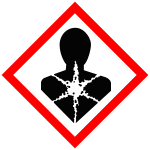
Respiratory sensitisation
H Phrases
-
H360D : May damage the unborn child.
Repr. (Cat. 1B) : Reproductive toxicity
Specific health risks
According to IARC ?
Substances classified by the International Agency for Research on Cancer (IARC/WHO) according to their evidence of carcinogenicity in humans. Groups range from 1 (proven human carcinogen) to 4 (probably not carcinogenic to humans). The IARC classification is an international reference in occupational and environmental health.
Prohibited for pregnant workers
Substances prohibited for pregnant workers
ListSpecific environmental risks
Persistent bioaccumulative and toxic ?
Substances identified as Persistent, Bioaccumulative and Toxic (PBT) according to the criteria of Annex XIII of the REACH Regulation. They pose a special risk of accumulation in the environment and in the food chain.
Hazardous water substances (Germany) ?
Substances classified with chronic aquatic toxicity under the CLP Regulation (H410–H413 phrases, Aquatic Chronic categories 1 to 4). They pose a long-term hazard to aquatic organisms, even at low concentrations and through prolonged exposure.
Restriction/prohibition regulations
Restricted substances under REACH ?
Substances listed in Annex XVII of the REACH Regulation (EC) No 1907/2006, subject to restrictions on their manufacture, placing on the market or use. Restrictions may be total or partial, limiting specific applications, maximum concentrations or user groups.
2. Shall not be manufactured, or used, as a substance on its own, as a constituent of other substances, or in mixtures in a concentration equal to or greater than 0,3 % after 23 December 2026 unless manufacturers and downstream users take the appropriate risk
management measures and provide the appropriate operational conditions to ensure that
exposure of workers is below the DNELs specified in paragraph 1.
Substances under PACT evaluation ?
Substances under active regulatory monitoring through ECHA's PACT (Public Activities Coordination Tool). Allows tracking which regulatory authorities are examining a substance and what potential regulatory actions are being considered (restriction, SVHC identification, harmonised classification, etc.).