RISCTOX Database
Search and consult detailed information about specific chemical substances.
Search other substances
Identification
- Name:
- 1,1'-Biphenyl, 4,4'-diisocyanato-3,3'-dimethyl-@3,3'-dimethylbiphenyl-4,4'-diyl diisocyanate
- Name (English):
- 1,1'-Biphenyl, 4,4'-diisocyanato-3,3'-dimethyl-@3,3'-dimethylbiphenyl-4,4'-diyl diisocyanate
- CAS:
- 91-97-4
- EC/EINECS:
- 202-112-7
- Molecular Formula:
- C16-H12-N2-O2
CLASSIFICATION AND LABELLING (Regulation 1272/2008)
Symbols
-
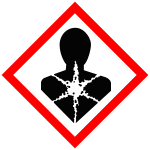
Respiratory sensitisation
H Phrases
-
H351 : Suspected of causing cancer
Carc. (Cat. 2) : Carcinogenicity
-
H334 : May cause allergy or asthma symptoms or breathing difficulties if inhaled
Sens.resp., 1
-
H317 : May cause an allergic skin reaction
Skin Sens. (Cat. 1A) : Respiratory/skin sensitization
Labelling
| Concentration | Labelling |
|---|---|
| Sens. cut., 1A; H 317 | C >= 0.001 % |
Specific health risks
According to IARC ?
Substances classified by the International Agency for Research on Cancer (IARC/WHO) according to their evidence of carcinogenicity in humans. Groups range from 1 (proven human carcinogen) to 4 (probably not carcinogenic to humans). The IARC classification is an international reference in occupational and environmental health.
Restriction/prohibition regulations
Restricted substances under REACH ?
Substances listed in Annex XVII of the REACH Regulation (EC) No 1907/2006, subject to restrictions on their manufacture, placing on the market or use. Restrictions may be total or partial, limiting specific applications, maximum concentrations or user groups.
2. 2. Shall not be placed on the market as substances on their own, as a constituent in other substances or in mixtures for industrial and professional use(s) after 24 February 2022, unless: (a) the concentration of diisocyanates individually and in combination is less than 0,1 % by weight, or
(b) the supplier ensures that the recipient of the substance(s) or mixture(s) is provided with information on the requirements referred to in point (b) of paragraph 1 and the following statement is placed on the packaging, in a manner that is visibly distinct from the rest of the label information: “As from 24 August 2023 adequate training is required before industrial or professional use”.
3. For the purpose of this entry “industrial and professional user(s)” means any worker or self-employed worker handling diisocyanates on their own, as a constituent in other substances or in mixtures for industrial and professional use(s) or supervising these tasks.
4. The training referred to in point (b) of paragraph 1 shall include the instructions for the control of dermal and inhalation exposure to diisocyanates at the workplace without prejudice to any national occupational exposure limit value or other appropriate risk management measures at national level. Such training shall be conducted by an expert on occupational safety and health with competence acquired by relevant vocational training. That training shall cover as a minimum:
(a) the training elements in point (a) of paragraph 5 for all industrial and professional use(s). (b) the training elements in points (a) and
(b) of paragraph 5 for the following uses:
- handling open mixtures at ambient temperature (including foam tunnels);
— spraying in a ventilated booth;
— application by roller;
— application by brush;
— application by dipping and pouring;
— mechanical post treatment (e.g. cutting) of not fully cured articles which are not warm anymore;
— cleaning and waste;
— any other uses with similar exposure through the dermal and/or inhalation route; (c) the training elements in points (a), (b) and (c) of paragraph 5 for the following uses: — handling incompletely cured articles (e.g. freshly cured, still warm);
— foundry applications; — maintenance and repair that needs access to equipment; — open handling of warm or hot formulations (> 45 °C);
— spraying in open air, with limited or only natural ventilation (includes large industry working halls) and spraying with high energy (e.g. foams, elastomers);
— and any other uses with similar exposure through the dermal and/or inhalation route.
5. Training elements:
(a) general training, including on-line training, on:
— chemistry of diisocyanates;
— toxicity hazards (including acute toxicity);
— exposure to diisocyanates;
— occupational exposure limit values;
— how sensitisation can develop;
— odour as indication of hazard;
— importance of volatility for risk;
— viscosity, temperature, and molecular weight of diisocyanates;
— personal hygiene;
— personal protective equipment needed, including practical instructions for its correct use and its limitations;
— risk of dermal contact and inhalation exposure;
— risk in relation to application process used;
— skin and inhalation protection scheme;
— ventilation;
— cleaning, leakages, maintenance;
— discarding empty packaging;
— protection of bystanders;
— identification of critical handling stages;
— specific national code systems (if applicable);
— behaviour-based safety;
— certification or documented proof that training has been successfully completed
(b) intermediate level training, including on-line training, on:
— additional behaviour-based aspects;
— maintenance;
— management of change;
— evaluation of existing safety instructions;
— risk in relation to application process used;
— certification or documented proof that training has been successfully completed
(c) advanced training, including on-line training, on:
— any additional certification needed for the specific uses covered;
— spraying outside a spraying booth;
— open handling of hot or warm formulations (> 45 °C);
— certification or documented proof that training has been successfully completed
6. The training shall comply with the provisions set by the Member State in which the industrial or professional user(s) operate. Member States may implement or continue to apply their own national requirements for the use of the substance(s) or mixture(s), as long as the minimum requirements set out in paragraphs 4 and 5 are met.
7. The supplier referred to in point (b) of paragraph 2 shall ensure that the recipient is provided with training material and courses pursuant to paragraphs 4 and 5 in the official language(s) of the Member State(s) where the substance(s) or mixture(s) are supplied. The training shall take into consideration the specificity of the products supplied, including composition, packaging, and design.
8. The employer or self-employed shall document the successful completion of the training referred to in paragraphs 4 and 5. The training shall be renewed at least every five years.
9. Member States shall include in their reports pursuant to Article 117(1) the following information:
a) any established training requirements and other risk management measures related to the industrial and professional uses of diisocyanates foreseen in national law;
(b) the number of cases of reported and recognised occupational asthma and occupational respiratory and dermal diseases in relation to diisocyanates;
(c) national exposure limits for diisocyanates, if there are any;
(d) information about enforcement activities related to this restriction.
10. This restriction shall apply without prejudice to other Union legislation on the protection of safety and health of workers at the workplace.
Substances under CoRAP evaluation ?
Substances included in the Community Rolling Action Plan (CoRAP) of the REACH Regulation. These are substances selected for evaluation by EU Member States due to indications of risk to human health or the environment, with the aim of clarifying whether regulatory action is warranted.
Substances under PACT evaluation ?
Substances under active regulatory monitoring through ECHA's PACT (Public Activities Coordination Tool). Allows tracking which regulatory authorities are examining a substance and what potential regulatory actions are being considered (restriction, SVHC identification, harmonised classification, etc.).