RISCTOX Database
Search and consult detailed information about specific chemical substances.
Search other substances
Identification
- Name:
- brodifacoum (ISO)@4-hydroxy-3-(3-(4'- bromo-4-biphenylyl)-1,2,3,4-tetrahydro-1-naphthyl)coumarin
- Synonyms:
-
- 4-hidroxi-3-(3-(4'- bromo-4-bifenilil)-1,2,3,4-tetrahidro-1-naftil)cumarina
- CAS:
- 56073-10-0
- EC/EINECS:
- 259-980-5
- Molecular Formula:
- C31H23BrO3
- Uses:
- pesticide rodenticide
Black list
Substances particularly hazardous to the environment or health
CLASSIFICATION AND LABELLING (Regulation 1272/2008)
Symbols
-
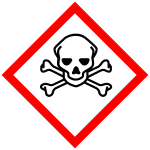
Acute toxicity (oral, dermal, inhalation)
-
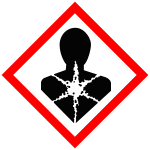
Respiratory sensitisation
-
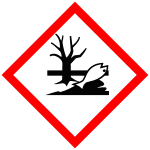
Hazardous to the aquatic environment
H Phrases
-
H360D : May damage the unborn child.
Repr. (Cat. 1A) : Reproductive toxicity
-
H330 : Fatal if inhaled
Acute Tox. (Cat. 1) : Acute toxicity
-
H310 : Fatal in contact with skin
Acute Tox. (Cat. 1) : Acute toxicity
-
H300 : Fatal if swallowed
Acute Tox. (Cat. 1) : Acute toxicity
-
H372 : Causes damage to organs through prolonged or repeated exposure
STOT RE (Cat. 1) : Specific target organ toxicity - repeated exposure
-
H400 : Very toxic to aquatic life
Aquatic Acute (Cat. 1) : Hazardous to the aquatic environment
-
H410 : Very toxic to aquatic life with long lasting effects
Aquatic Chronic (Cat. 1) : Hazardous to the aquatic environment
Labelling
| Concentration | Labelling |
|---|---|
| C = 0,003 % | Repr., 1A; H360D |
| C = 0,02 % | STOT repe., 1; H372 (blood) |
| 0,002 % = C < 0,02 % | STOT repe., 2; H373 (blood) |
| M = 10 | |
| M = 10 |
Specific health risks
Environmental regulations
Major accident hazards (Seveso) ?
Hazardous substances listed in Annex I of the Seveso III Directive (Directive 2012/18/EU), transposed in Spain by Royal Decree 840/2015. Their presence in industrial establishments in quantities equal to or above established thresholds triggers obligations to implement major accident risk control measures.
ListRestriction/prohibition regulations
Substances under evaluation. PACT ?
Substances under active regulatory monitoring through ECHA's PACT (Public Activities Coordination Tool). Allows tracking which regulatory authorities are examining a substance and what potential regulatory actions are being considered (restriction, SVHC identification, harmonised classification, etc.).