


RISCTOX Database
Search and consult detailed information about specific chemical substances.
Search other substances
Identification
- Name:
- 2,4-dinitrotoluene@2,4-DNT
- Synonyms:
-
- dinitrotolueno, grado tecnico [1]
- CAS:
- 121-14-2
- EC/EINECS:
- 204-450-0
- Molecular Formula:
- C7H6N2O4
- International Chemical Safety Card (ICSC):
- 0727
Black list
Substances particularly hazardous to the environment or health
CLASSIFICATION AND LABELLING (Regulation 1272/2008)
Symbols
-
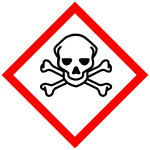
Acute toxicity (oral, dermal, inhalation)
-

Respiratory sensitisation
-

Hazardous to the aquatic environment
Signal word
DangerH Phrases
-
H350 : May cause cancer
-
H341 : Suspected of causing genetic defects
-
H361f : Suspected of damaging fertility.
-
H331 : Toxic if inhaled
-
H311 : Toxic in contact with skin
-
H301 : Toxic if swallowed
-
H373 : May cause damage to organs through prolonged or repeated exposure
-
H400 : Very toxic to aquatic life
-
H410 : Very toxic to aquatic life with long lasting effects
Specific health risks
Breast cancer ?
Substances classified with H362 phrase (may cause harm to breast-fed children). Toxic for reproduction due to effects on lactation or due to transmissibility through breast milk.
Carcinogens (other sources) ?
Substances classified as carcinogens or mutagens Category 3 under the Dangerous Preparations Directive criteria (pre-CLP). Substances with limited evidence or indications of carcinogenicity or mutagenicity.
Neurotoxic substances ?
According to IARC ?
Substances classified as carcinogens or mutagens Category 2 under the CLP Regulation (GHS), bearing H351 and/or H341 phrases. These are substances suspected of causing cancer or heritable genetic mutations in humans.
Occupational Exposure Limits (OEL) ?
Daily exposure limit values (VLA-ED) published by the Spanish National Institute of Safety and Health at Work (INSST). They represent the average concentration of a chemical agent in the worker's breathing zone, measured or calculated in a time-weighted manner for an 8-hour daily working period. (https://www.insst.es/valores-limites-de-exposicion)
Specific environmental risks
Persistent bioaccumulative and toxic ?
Substances identified as Persistent, Bioaccumulative and Toxic (PBT) according to the criteria of Annex XIII of the REACH Regulation. They pose a special risk of accumulation in the environment and in the food chain.
Restriction/prohibition regulations
Restricted substances under REACH ?
Substances listed in Annex XVII of the REACH Regulation (EC) No 1907/2006, subject to restrictions on their manufacture, placing on the market or use. Restrictions may be total or partial, limiting specific applications, maximum concentrations or user groups.
for professional users or the general public, in a concentration equal to or greater than 0,1
% by weight.
2. For the purpose of this entry, “professional user” shall mean any worker or self-employed
worker operating outside of industrial sites.
3. Paragraph 1 shall not apply to:
(a) explosives, as defined in Article 2, point (1), of Directive 2014/28/EU;
(b) articles for military use;
(c) ammunition for use, in accordance with national law, by the police or other security
forces;
(d) toys within the scope of Regulation (EU) 2025/2509 of the European Parliament and
Council1;
(e) devices within the scope of Regulation (EU) 2017/745;
(f) articles intended to come into contact with food, within the scope of Regulation (EC)
No 1935/2004.
4. The following shall not be covered by paragraph 3(a):
(a) pyrotechnic articles, as defined in Article 3, point (1), of Directive 2013/29/EU;
(b) ammunition.
5. Paragraph 1, shall apply from 11 May 2029 to the placing on the market and use of 2,4-
dinitrotoluene in the following applications, where they are placed on the market for use, or
used in motor vehicles as defined in Article 3, point (16), of Regulation (EU) 2018/858 of the
European Parliament and of the Council2:
(a) micro gas generators for seat belt pre-tensioners and bonnet actuators;
(b) spare parts.
6. Paragraph 1 shall not apply to motor vehicles referred to in paragraph 5, that meet the
following conditions:
(a) were placed on the market between 11 May 2027 and 11 May 2029;
(b) contain 2,4-dinitrotoluene only in applications listed in paragraph 5, point (a) or
point (b).
7. Paragraph 1 shall not apply to 2,4-dinitrotoluene in articles placed on the market in the
Union before 11 May 2027.
-------------
1 Regulation (EU) 2025/2509 of the European Parliament and of the Council of 26 November 2025 on the
safety of toys and repealing Directive 2009/48/EC (OJ L, 2025/2509, 12.12.2025, ELI:
http://data.europa.eu/eli/reg/2025/2509/oj)
2 Regulation (EU) 2018/858 of the European Parliament and of the Council of 30 May 2018 on the approval and market surveillance of motor vehicles and their trailers, and of systems, components and
separate technical units intended for such vehicles, amending Regulations (EC) No 715/2007 and (EC) No
595/2009 and repealing Directive 2007/46/EC (OJ L 151, 14.6.2018, p. 1, ELI:
http://data.europa.eu/eli/reg/2018/858/oj)
Substances subject to REACH authorization ?
Substances listed in Annex XIV of the REACH Regulation, subject to the prior authorisation scheme. To use them after the sunset date, companies must obtain authorisation from ECHA, demonstrating adequate risk control or the absence of viable alternatives.
ListREACH Candidates ?
Substances of Very High Concern (SVHC) identified by ECHA and included on the REACH Candidate List. These are substances with CMR, PBT, vPvB or endocrine disrupting properties liable to be included in Annex XIV (authorisation). Their inclusion generates notification obligations for articles containing them.
ListMajor accident hazards (Seveso) ?
Hazardous substances listed in Annex I of the Seveso III Directive (Directive 2012/18/EU), transposed in Spain by Royal Decree 840/2015. Their presence in industrial establishments in quantities equal to or above established thresholds triggers obligations to implement major accident risk control measures.
ListSubstances under PACT evaluation ?
Substances under active regulatory monitoring through ECHA's PACT (Public Activities Coordination Tool). Allows tracking which regulatory authorities are examining a substance and what potential regulatory actions are being considered (restriction, SVHC identification, harmonised classification, etc.).