

RISCTOX Database
Search and consult detailed information about specific chemical substances.
Search other substances
Identification
- Name:
- (S)-α-cyano-3-phenoxybenzyl-(S)-2-(4-chlorophenyl)-3-methylbutyrate@esfenvalerate (ISO)
- Name (English):
- (S)-α-cyano-3-phenoxybenzyl-(S)-2-(4-chlorophenyl)-3-methylbutyrate@esfenvalerate (ISO)
- Synonyms:
-
- esfenvalerato
- (S)-2-(4-clorofenil)-3-metil-butirato de (S)-α-ciano-3-fenoxibencilo
- CAS:
- 66230-04-4
- Uses:
- insecticide pesticide
Black list
Substances particularly hazardous to the environment or health
CLASSIFICATION AND LABELLING (Regulation 1272/2008)
Symbols
-
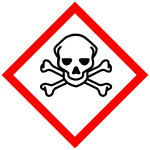
Acute toxicity (oral, dermal, inhalation)
-
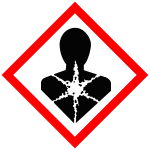
Respiratory sensitisation
-
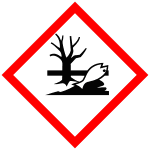
Hazardous to the aquatic environment
Signal word
DangerH Phrases
-
H331 : Toxic if inhaled
Acute Tox. (Cat. 3) : Acute toxicity
-
H301 : Toxic if swallowed
Acute Tox. (Cat. 3) : Acute toxicity
-
H370 : Causes damage to organs
STOT SE (Cat. 1) : Specific target organ toxicity - single exposure
-
H373 : May cause damage to organs through prolonged or repeated exposure
STOT RE (Cat. 2) : Specific target organ toxicity - repeated exposure
-
H317 : May cause an allergic skin reaction
Skin Sens. (Cat. 1) : Respiratory/skin sensitization
-
H400 : Very toxic to aquatic life
Aquatic Acute (Cat. 1) : Hazardous to the aquatic environment
-
H410 : Very toxic to aquatic life with long lasting effects
Aquatic Chronic (Cat. 1) : Hazardous to the aquatic environment
Labelling
| Concentration | Labelling |
|---|---|
| C >= 0,0025 % | N; R50-53 |
| 0,00025 % <= C < 0,0025 % | N; R51-53 |
| 0,000025 % <= C < 0,00025 % | R52-53 |
| ATE = 88,5 mg/kg bw | Oral |
| ATE = 0,53 mg/l | Inhalation (dusts or mists) |
| M= 10 000 | |
| M= 10 000' |
Specific environmental risks
Persistent bioaccumulative and toxic ?
Substances identified as Persistent, Bioaccumulative and Toxic (PBT) according to the criteria of Annex XIII of the REACH Regulation. They pose a special risk of accumulation in the environment and in the food chain.
Atmospheric emissions ?
Substances subject to atmospheric emission limitations under the Industrial Emissions Directive (2010/75/EU) and its Spanish transposition. Includes pollutants regulated in industrial installation emission permits and best available technique reference documents (BAT/BREF).
ListEnvironmental regulations
LPCIC (EPER)
Priority substances and specific pollutants within the EU water policy framework, established by the Water Framework Directive (2000/60/EC) and the Priority Substances Directive (2008/105/EC and amendments). Substances posing significant risk to European surface waters and subject to Environmental Quality Standards (EQS).
Restriction/prohibition regulations
Substances under PACT evaluation ?
Substances under active regulatory monitoring through ECHA's PACT (Public Activities Coordination Tool). Allows tracking which regulatory authorities are examining a substance and what potential regulatory actions are being considered (restriction, SVHC identification, harmonised classification, etc.).
Authorized Pesticide ?
Active substances approved for use in plant protection products (agricultural pesticides) in the European Union under Regulation (EC) No 1107/2009. Includes herbicides, fungicides, insecticides, acaricides and other crop protection agents with current European-level approval.
Banned biocides ?
Active substances whose approval for biocidal use has been denied or not renewed under Regulation (EU) No 528/2012 on biocidal products. They may not be placed on the market or used as active substances in biocidal products in the European Union.
Major accident hazards (Seveso) ?
Hazardous substances listed in Annex I of the Seveso III Directive (Directive 2012/18/EU), transposed in Spain by Royal Decree 840/2015. Their presence in industrial establishments in quantities equal to or above established thresholds triggers obligations to implement major accident risk control measures.
List